Wellbeing International Foundation Ltd - THE BUSINESS OF HOPE
- Bernie Madoff
- Apr 17
- 4 min read

Inside the shadowy world of stem cell therapies — and the companies operating between science and regulation.
There is a moment — often quiet, often desperate — when a patient stops asking “Can I be cured?” and starts asking something far more dangerous:
“What else is out there?”
It is in that moment that an entire industry is waiting.
Not in hospitals. Not in clinical trial centres.But in polished consulting rooms, high-end websites, and private appointments — often carrying the language of science, but not always its substance.
At the centre of this growing global market is a powerful idea:that the body can heal itself, if only the right cells are unlocked.
Stem cells are real. Their potential is undeniable.But somewhere between laboratory science and commercial opportunity, a second industry has emerged — one that trades not just in treatment, but in hope.
A Consultation on Harley Street
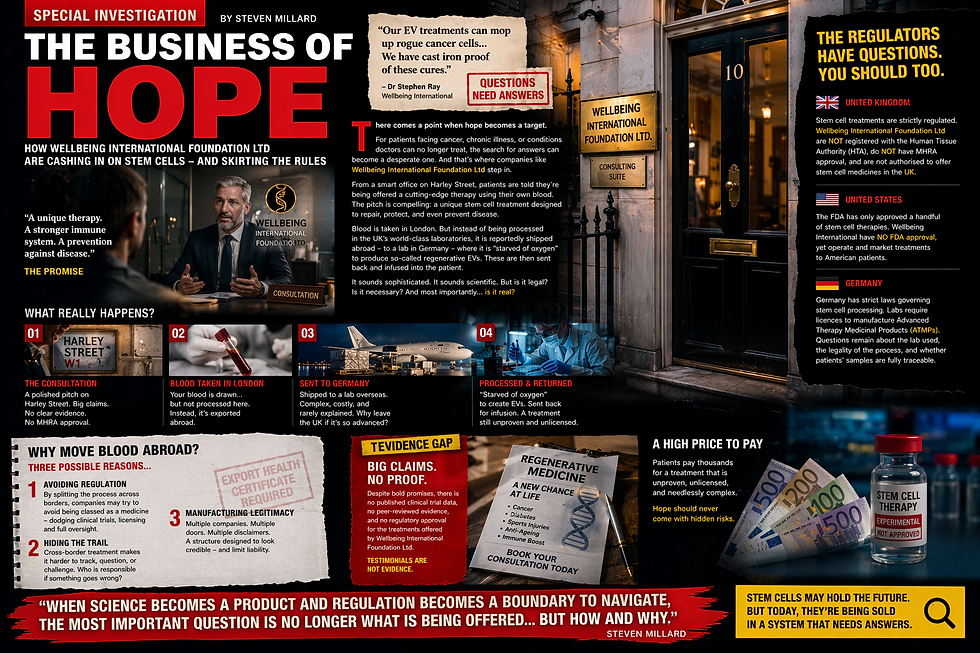
Inside a serviced office on Harley Street — one of London’s most recognisable medical addresses — a patient sits across from a consultant representing Wellbeing International Foundation Ltd.
He is not speaking to a hospital.He is not entering a clinical trial.
He is being offered something else.
A procedure is described. Blood will be taken in London. It will then be transported abroad — to a laboratory in Germany — where it will undergo a process designed to produce what are described as regenerative components. These are then returned to the patient via infusion.
The language is confident. The claims are expansive.
According to the consultation, the treatment may support recovery, enhance the immune system, and in some cases, even act as a preventative measure against serious disease.
To a patient with limited options, it sounds like possibility.
But step back — and a different set of questions begins to emerge.
What Is Actually Allowed?
In the United Kingdom, stem cell therapy is not a free-for-all. It is one of the most tightly regulated areas of modern medicine.
Any treatment involving the manipulation of human cells is likely to fall under the authority of theMedicines and Healthcare products Regulatory Agency,which classifies such interventions as medicinal products.
At the same time, the handling and storage of human tissue must comply with theHuman Tissue Authority.
And where embryonic material is involved, oversight extends to theHuman Fertilisation and Embryology Authority.
The system is designed with one purpose:
To ensure that any treatment offered to patients is proven, tested, and safe.
Outside of a small number of approved therapies — primarily involving blood-related conditions — most stem cell applications remain experimental.
Which raises a fundamental issue:
If a treatment is being marketed as effective, where is the evidence — and under whose approval?
A Treatment That Leaves the Country
One of the most striking elements in cases such as those involving Wellbeing International Foundation Ltd is not just the treatment itself — but its journey.
Blood is drawn in London.
It is then transported across borders — reportedly to Germany — for processing.
On the surface, this may appear to be a technical detail.
In reality, it may be the most important part of the story.
Transporting human biological material post-Brexit is neither simple nor cheap. It requires:
Export health certification
Controlled temperature logistics
Full traceability and documentation
Compliance with both UK export and EU import regulations
This is not a casual process. It is a regulated chain.
So the question becomes unavoidable:
Why move biological material out of one of the world’s leading medical systems — if the treatment itself is legitimate, approved, and deliverable within it?
The Regulatory Gap
Across Europe and the United States, stem cell therapies are governed by strict frameworks.
In the US, the U.S. Food and Drug Administration classifies most stem cell interventions as biological drugs — requiring approval before they can be marketed.
In Germany, treatments fall under the Advanced Therapy Medicinal Products (ATMP) framework, requiring licensing and regulatory oversight.
In theory, these systems leave little room for ambiguity.
In practice, however, a gap has emerged.
Some organisations appear to operate across multiple jurisdictions — consulting in one country, processing in another, administering elsewhere — creating a structure that is difficult to follow, and even harder to regulate.
This is not necessarily a direct breach of the law.
But it may represent something more subtle:
A system built to sit just outside of it.
Multiple Doors, One Treatment
Another recurring feature is structure.
Patients do not encounter a single entity.They encounter layers.
A consultancy
A foundation
A laboratory partner
A treatment provider
Each operating within its own defined role.
Individually, each component may appear compliant.
Collectively, they form a chain in which responsibility becomes diffuse.
If something goes wrong, where does accountability begin — and where does it end?
The Question of Evidence
Perhaps the most critical issue is not logistical, but scientific.
Modern medicine is built on a simple principle:
Claims must be proven.
That proof comes in the form of:
Controlled clinical trials
Peer-reviewed data
Regulatory approval
Without these, treatments remain experimental.
Yet many of the claims made in this space — including those described in consultations linked to Wellbeing International Foundation Ltd — extend beyond what is currently supported by established clinical evidence.
That does not automatically make them false.
But it does mean they remain unverified.
And in medicine, that distinction matters.
The Cost of Complexity
To the patient, the system may appear seamless.
Consultation. Payment. Treatment.
But behind that experience lies a structure that is:
Cross-border
Multi-entity
Scientifically complex
Legally fragmented
It is a system that requires trust.
And trust, in medicine, is supposed to be built on evidence.
A Final Question
Stem cell science is one of the most promising frontiers in modern medicine.
There is no doubt that, in time, it will transform lives.
But today, there are two parallel realities:
One grounded in research, regulation, and proof.
The other operating in the space between them.
The challenge for patients is not simply deciding whether a treatment might help.
It is understanding whether it has ever been shown to work —and why, if it has, it needs to travel so far, pass through so many hands, and operate across so many boundaries to do so.


Comments