THE STEM CELL GOLD RUSH: HOW A GLOBAL INDUSTRY IS SELLING HOPE WITHOUT PROOF
- Bernie Madoff
- Apr 24
- 5 min read

There is a quiet industry operating in plain sight — one that promises miracles, sells hope, and often delivers neither.
It does not operate in the shadows in the traditional sense. It advertises openly. It holds seminars. It uses glossy websites, smiling doctors, and persuasive testimonials. It speaks the language of science, but frequently avoids its discipline.
This is the modern stem cell marketplace — and in 2026, it is under increasing scrutiny from courts, regulators, and investigators alike.
A Turning Tide: Courts Begin to Act
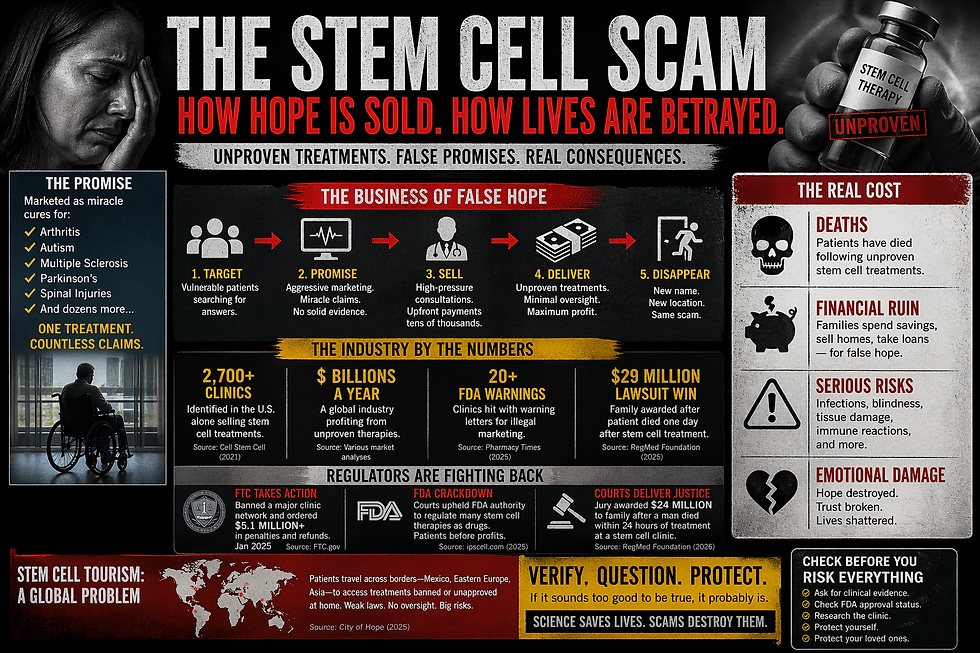
In January 2025, a significant legal precedent was set when U.S. authorities took decisive action against a network of clinics operating under the banner of the Stem Cell Institute of America.
The outcome was stark.
A federal court permanently banned the company’s founders from marketing stem cell therapies and ordered them to pay over $5.1 million in penalties and refunds after findings that patients had been misled with false claims.
👉 Read the full case:FTC enforcement action on stem cell clinics
The allegations were not subtle. According to regulators, the network trained practitioners to:
Run “educational seminars” designed to recruit vulnerable patients
Market treatments for multiple conditions without scientific backing
Use persuasive sales tactics rather than medical evidence
This was not fringe activity. It was structured, scalable, and profitable.
When Hope Turns Fatal
Behind the marketing lies a darker reality.
In one recent U.S. case, a jury awarded $24 million to the family of a patient who died within 24 hours of receiving stem cell treatment, a landmark moment signalling that civil courts may now be stepping in where regulators have struggled.
These cases are increasingly difficult to dismiss as isolated incidents.
Medical experts have repeatedly warned that unregulated stem cell interventions can lead to:
Severe infections
Tissue damage
Blindness
Death
And yet, the industry continues to expand.
Science vs Sales Pitch
The core issue is not whether stem cell science holds promise — it undoubtedly does.
Legitimate therapies exist, particularly in areas such as blood disorders and immune conditions. But these are tightly regulated, clinically tested, and approved through rigorous scientific processes.
The problem lies in what happens outside that system.
According to regulatory analysis, many clinics are selling treatments with little or no reliable evidence to support their claims, often targeting a wide range of unrelated conditions.
👉 Background on regulatory concerns:FDA overview of regenerative medicine risks
From arthritis to autism, Parkinson’s to spinal injuries — the same injections are frequently marketed as a universal solution.
This is not innovation.
It is a red flag.
Regulators Are Catching Up — Slowly
Authorities are beginning to respond, but often reactively rather than proactively.
The U.S. Food and Drug Administration (FDA) has issued multiple warnings and pursued legal action against clinics offering unapproved therapies. In one key legal battle, the courts reinforced the FDA’s authority by ruling that certain stem cell preparations — including fat-derived cell mixtures — should legally be classified as drugs.
👉 Legal analysis of the ruling:FDA court victory on stem cell clinic regulation
This matters.
Because once classified as a drug, these treatments must meet strict safety and efficacy standards — something many clinics cannot demonstrate.
But enforcement remains fragmented.
Shut down one clinic, and another often appears under a new name, a new company, or in a different jurisdiction.
The Rise of a Global Grey Market
Perhaps the most troubling development is the internationalisation of the industry.
Patients are increasingly travelling abroad in search of treatments unavailable — or illegal — in their home countries.
This phenomenon, often referred to as stem cell tourism, has created a global network of clinics operating in regulatory grey zones.
In some cases:
Consultations take place in one country
Payments are processed in another
Treatments are delivered in a third
This fragmentation makes enforcement extremely difficult.
And for patients, it creates a dangerous lack of accountability.
The Business Model of False Hope
Strip away the branding, and a consistent pattern emerges.
Many of these operations rely on a familiar formula:
1. Target the vulnerable
Patients with chronic conditions, terminal diagnoses, or limited treatment options are the primary audience.
2. Offer a breakthrough
Language such as “cutting-edge,” “regenerative,” and “life-changing” is used liberally.
3. Avoid specifics
Scientific detail is often replaced with vague explanations and anecdotal success stories.
4. Secure upfront payment
Treatments can cost tens of thousands, typically paid out-of-pocket.
5. Shift responsibility
When outcomes fail, clinics frequently attribute results to individual variability rather than treatment efficacy.
This is not theoretical.
The FTC case revealed that patients were “tricked… into buying expensive, unproven stem cell therapy”, a blunt assessment from regulators themselves.
The Illusion of Legitimacy
One of the most effective tools in this industry is presentation.
Clinics often:
Operate from prestigious addresses
Use medical titles and imagery
Reference scientific studies (often unrelated or misrepresented)
Promote “clinical trials” that lack proper registration or oversight
To the average patient, the distinction between legitimate research and marketing spin is almost impossible to detect.
And that is precisely the point.
A Regulatory Gap Exploited
Despite increasing enforcement, the regulatory framework remains inconsistent across regions.
In some jurisdictions, legislation is actually moving in the opposite direction — loosening restrictions under the banner of “medical freedom.”
This creates an environment where:
Clinics can legally operate without robust evidence
Patients are left to assess risk themselves
Oversight becomes optional rather than mandatory
The result is a fragmented system where the same treatment may be illegal in one country and openly marketed in another.
The Scale of the Industry
The numbers are difficult to pin down precisely, but previous estimates identified thousands of clinics operating in the United States alone, with many more worldwide.
And the trend is not slowing.
Digital marketing has accelerated growth, allowing clinics to:
Target patients globally
Use social media testimonials
Run webinars and “education sessions”
Build trust remotely before patients ever step into a clinic
What Investigations Are Beginning to Reveal
Undercover investigations — including those conducted by journalists, regulators, and independent researchers — are starting to expose common patterns:
Pop-up clinics operating from rented medical spaces
Sales-driven consultations resembling timeshare pitches
Cash or offshore payment structures
Minimal clinical infrastructure behind bold claims
In some cases, the gap between appearance and reality is striking.
A polished reception area may mask the absence of:
Laboratory facilities
Clinical trial data
Long-term patient monitoring
The Human Cost
Behind every statistic is a story.
Families spending life savings.
Patients travelling across continents.
Hope being sold as certainty.
And, in some cases, lives being lost.
The tragedy is not just financial — it is emotional, psychological, and, increasingly, medical.
Where This Leaves Us
The stem cell industry sits at a crossroads.
On one side:
Genuine scientific progress
Breakthrough therapies
Real medical potential
On the other:
Aggressive marketing
Weak regulation
Exploitation of vulnerable patients
The challenge is separating one from the other.
Final Word
What is emerging is not simply a regulatory issue.
It is a structural one.
A global marketplace where:
Science is used as a branding tool
Hope is monetised
Oversight struggles to keep pace
And until that balance shifts, the question remains:
How many more patients will pay the price before the system catches up?


Comments