THE PART OF THIS INVESTIGATION I NEVER EXPECTED
- Bernie Madoff
- Jun 19
- 4 min read

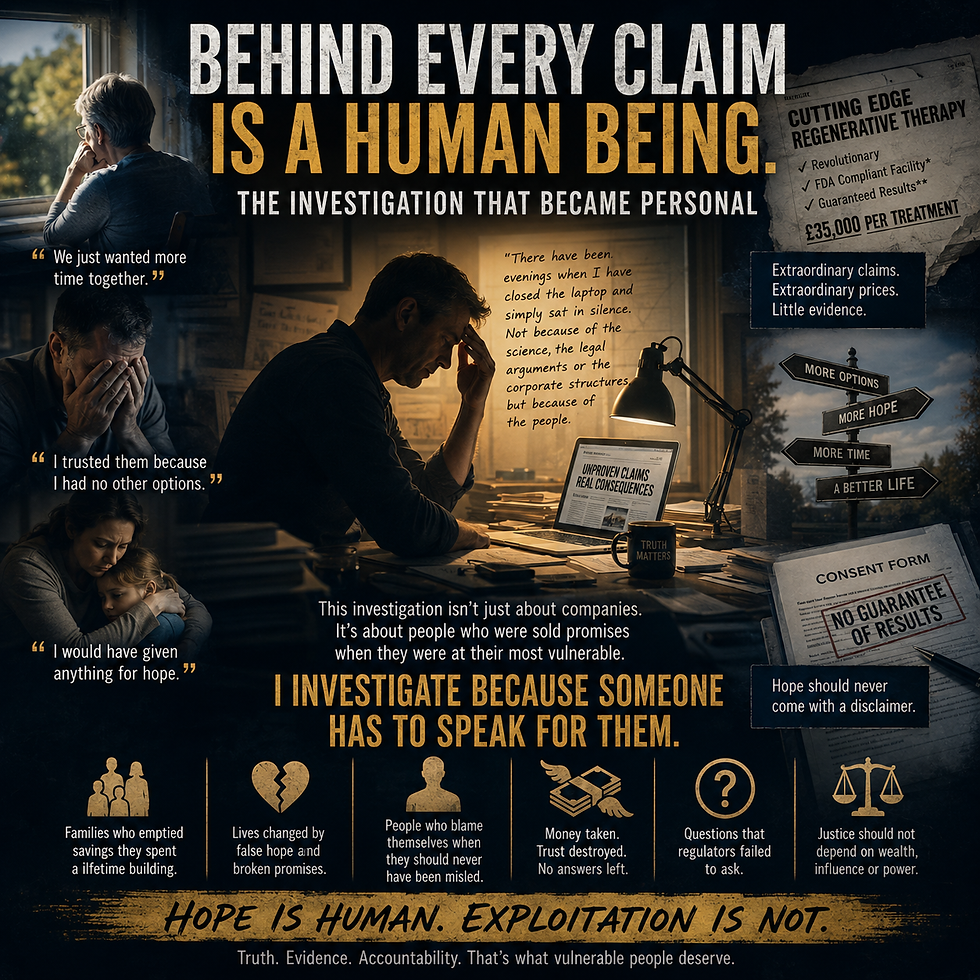
When I first started investigating companies operating within the stem cell and regenerative medicine sector, I thought I knew what I was looking for.
Like most investigators, I began with the facts. I wanted to understand the science being presented to patients, the claims being made on websites, the corporate structures behind the businesses, and whether the treatments being sold could genuinely deliver what was being promised. It was, at least in the beginning, a straightforward exercise in research. There were documents to review, interviews to conduct, websites to analyse and claims to verify.
What I didn't expect was how personal the journey would become.
Over the months that followed, I found myself spending countless hours reading patient testimonials, reviewing recordings, studying marketing material and listening to conversations between providers and people searching desperately for answers. At first, I viewed these interactions through the lens of an investigator. I was looking for inconsistencies, exaggerations and evidence. I was trying to establish what was true and what wasn't.
But somewhere along the way, something changed.
I stopped seeing case files.
I started seeing people.
Behind every enquiry was a human being facing a reality most of us hope we never have to experience. There were men and women living with degenerative diseases, chronic pain, neurological disorders and terminal diagnoses. There were parents looking for help for their children and families desperately searching for anything that might offer relief. Some had exhausted every conventional option available to them. Others had been told there was little more that medicine could do.
Many were not looking for miracles.
They were looking for possibility.
That distinction stayed with me because it became increasingly clear that the commodity being traded within parts of this industry is not necessarily treatment.
It is hope.
Hope is an extraordinary thing. It has carried people through the darkest moments imaginable. It has driven medical breakthroughs, inspired scientific discovery and given strength to those facing impossible circumstances. Without hope, progress would never happen.
But hope also has another side.
When people are frightened, vulnerable and running out of options, hope can become incredibly valuable. Valuable enough that some will spend their savings pursuing it. Valuable enough that families will remortgage homes, empty retirement funds or travel across continents in search of it. Valuable enough that people will place their trust in complete strangers because they need to believe that somebody, somewhere, has found an answer.
As I continued my investigation, I found that this was the aspect I struggled with most.
Not the science.
Not the medicine.
Not even the money.
What troubled me was the thought that there are individuals and organisations willing to build businesses around that vulnerability.
Perhaps that sounds naïve. Maybe every industry contains people motivated more by profit than principle. But there is something uniquely unsettling about seeing suffering transformed into a commercial opportunity.
The more stories I encountered, the more difficult it became to separate the investigation from the human cost. I spoke with families who had invested enormous sums of money into treatments they believed would change their lives. I heard accounts from people who felt they had been given expectations that were never realistically achievable. Some were angry. Others were embarrassed. Many simply felt heartbroken.
What struck me most was how often they blamed themselves.
They would say they should have asked more questions. They should have done more research. They should have known better.
But I never saw it that way.
Most of these people were not reckless. They were not foolish. In many cases they were highly intelligent, successful individuals who had spent a lifetime making sensible decisions. The difference was that they had found themselves facing circumstances that few people are ever truly prepared for.
Illness changes the way people think.
Pain changes the way people think.
The fear of losing a loved one changes the way people think.
When someone you care about is deteriorating, when conventional medicine has no easy answers, or when you are told to simply manage your condition rather than overcome it, the desire to believe in something better becomes incredibly powerful. In those moments, people are not making decisions from a position of strength. They are making decisions from a position of hope.
That is why I believe those operating within this sector carry such a profound responsibility.
The greater the claim, the greater the burden of proof.
The more vulnerable the patient, the greater the duty of care.
The more life-changing the promise, the stronger the evidence should be.
Those principles should not be controversial. They should be fundamental.
This investigation has taken me into a world of complex science, regulatory grey areas, offshore companies, marketing campaigns and competing expert opinions. Yet despite all of that complexity, I find myself returning to a remarkably simple thought.
There is a person at the centre of every one of these transactions.
A real person.
A father hoping to see his daughter get married.
A mother searching for more time with her family.
A husband trying to preserve his independence.
A wife desperate to slow the progression of a disease that is gradually taking pieces of the life she once knew.
When viewed through that lens, the discussion stops being about treatments and business models. It becomes a question of ethics, responsibility and humanity.
People sometimes ask why I continue investigating these companies.
The answer is simple.
Because behind every headline is a family.
Behind every payment is a story.
And behind every promise is a responsibility that should never be taken lightly.
I have no illusion that one article will change an industry. It won't. Nor do I believe that every company operating in this space is motivated by bad intentions. That would be neither fair nor accurate.
What I do believe is that vulnerable people deserve transparency. They deserve honesty. They deserve evidence. Most importantly, they deserve protection from anyone willing to exploit their circumstances for financial gain.
If these investigations achieve anything at all, I hope they encourage people to ask questions, to seek independent advice and to look beyond the marketing before making life-changing decisions.
Because after everything I have seen, one thing has become abundantly clear.
The true victims in this story are not found in company records, scientific papers or court filings.
They are found sitting around kitchen tables, holding onto hope, and trusting that the people offering it have earned that trust. Steven Millard Investigator/Journalist.


Comments