THE MEN BEHIND WELLBEING — Chapter Two

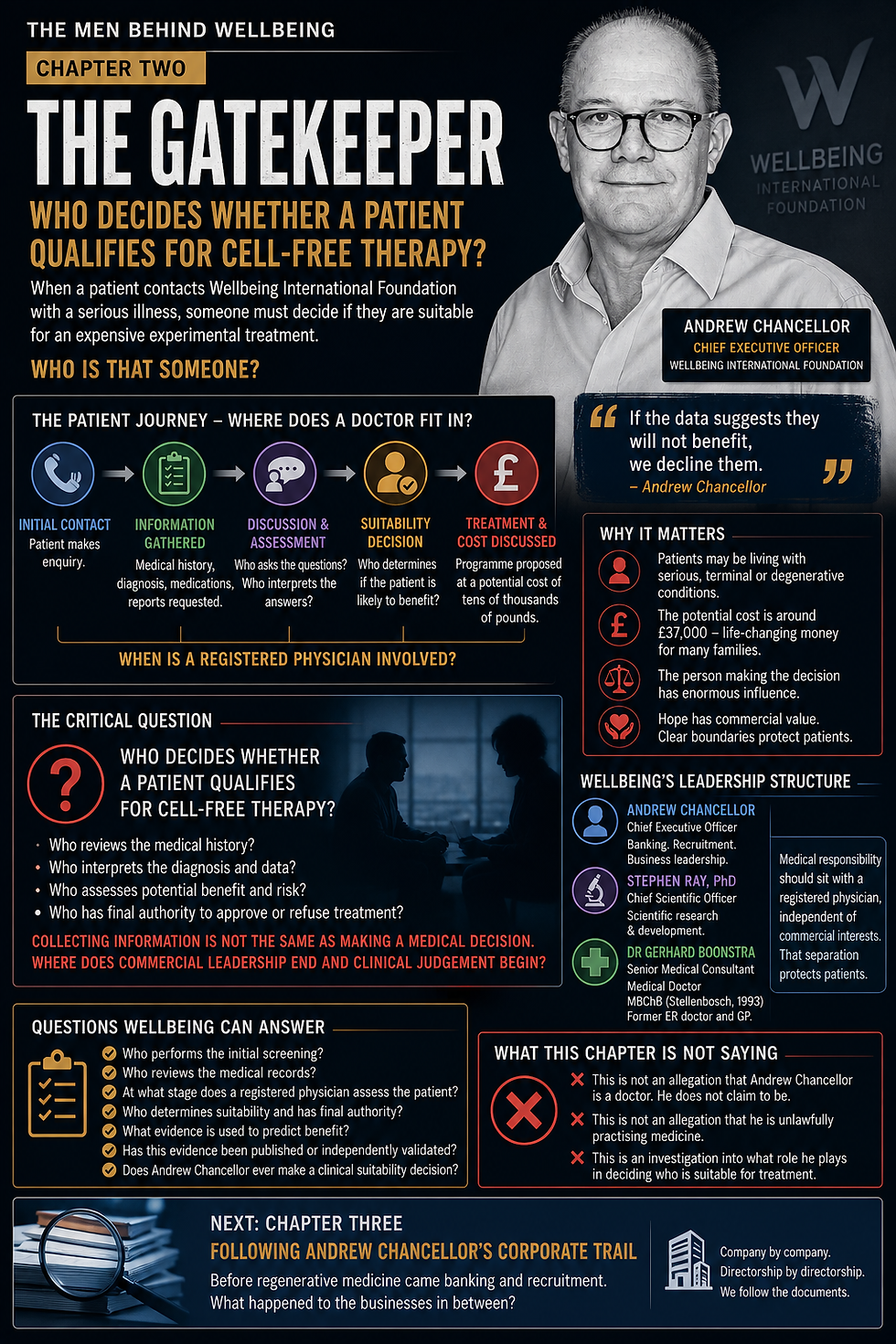
The Gatekeeper
Who decides whether a patient qualifies for Cell-Free Therapy?
There is a point at which a biotechnology business stops being an abstract discussion about science.
A patient picks up the telephone.
They may be frightened.
They may have exhausted conventional options.
They may be living with a serious illness or degenerative condition.
They want to know one thing:
Can you help me?
For Wellbeing International Foundation, answering that question is particularly important.
Cell-Free Therapy is not presented as an inexpensive wellness supplement. The programme discussed during my investigation carried a potential cost of tens of thousands of pounds.
So before a patient commits that kind of money, somebody has to decide whether they are suitable.
Who makes that decision?
That question led me back to Wellbeing's Chief Executive Officer:
Andrew Chancellor.
The Patient Journey
Wellbeing describes a process in which prospective patients are assessed before progressing to Cell-Free Therapy.
On the face of it, this is reassuring.
Not everybody should be accepted for an experimental or emerging biological intervention.
Medical history matters.
Diagnosis matters.
Medication matters.
Existing conditions matter.
Potential risks matter.
A responsible organisation should have a mechanism for identifying patients for whom an intervention is inappropriate.
Andrew Chancellor has publicly discussed this selection process himself.
He has explained that Wellbeing does not accept everyone and has stated:
“If the data suggests they will not benefit, we decline them.”
It sounds like an admirable principle.
But it raises a remarkably important question.
Who evaluates the data?
Who Is “We”?
That single word deserves examination.
“We.”
Does Chancellor mean Wellbeing's physicians?
A multidisciplinary clinical team?
Scientists?
An external doctor?
Or does the CEO himself participate in determining whether a patient is suitable?
These distinctions matter.
Because, as established in Chapter One, Wellbeing does not publicly identify Chancellor as a medical doctor.
His documented career began in banking.
He subsequently worked in international recruitment.
He later entered healthcare and bioscience and ultimately became Wellbeing's CEO.
Wellbeing separately identifies a medically qualified physician within its senior team.
So where exactly does Chancellor sit in the patient-assessment process?
The Difference Between Screening and Medicine
There is nothing unusual about non-medical staff speaking with prospective patients.
Hospitals do it.
Private clinics do it.
Medical practices do it.
A patient coordinator can collect someone's name, medical history and records.
An administrator can arrange appointments.
A salesperson can explain prices.
A CEO can explain the organisation and its technology.
But there is potentially an important boundary.
Collecting medical information is one thing.
Interpreting it is another.
Explaining a treatment is one thing.
Determining whether it is medically appropriate for an individual is another.
Discussing published research is one thing.
Predicting that a particular patient may benefit is another.
That boundary is exactly what this investigation now needs to establish.
The Patient Evidence
My investigation has included prospective-patient interactions with Wellbeing.
That material now needs to be considered differently.
Initially, I was interested primarily in what was being said about Cell-Free Therapy.
Now I am equally interested in who was saying it.
The sequence matters.
When medical conditions were discussed:
Who asked the questions?
Who interpreted the answers?
Who discussed possible benefits?
Who determined suitability?
Was Chancellor gathering information to pass to a doctor?
Or was he himself expressing a judgement about whether treatment was appropriate?
And crucially:
Had a registered physician independently assessed the patient's medical information before any conclusion about suitability was communicated?
Those questions can be answered only by reconstructing the communications carefully.
This Is Not About Job Titles
It would be easy to make this investigation about whether Chancellor calls himself a doctor.
I have found no evidence that he does.
Wellbeing identifies him as CEO.
The issue is therefore not his title.
It is his function.
A person does not need to describe themselves as a physician for questions to arise about the nature of advice they are providing.
What matters is what actually happens during the interaction.
If Chancellor explains Wellbeing's technology, introduces its services and arranges a physician consultation, that is one scenario.
If he evaluates someone's medical condition and determines that they are clinically suitable for treatment, that is another.
The evidence must tell us which applies.
Where Is the Doctor?
This brings us to Dr Gerhard Boonstra.
Unlike Chancellor, Wellbeing identifies Boonstra as medically qualified.
His company biography states that he obtained his medical degree from Stellenbosch University and subsequently worked in emergency medicine and general practice.
Wellbeing identifies him as its senior medical consultant.
That creates an obvious expectation.
When a patient approaches Wellbeing, at what stage does Dr Boonstra—or another appropriately registered physician—become involved?
Before suitability is discussed?
After?
Before the price is presented?
After the patient agrees to proceed?
Before payment?
Immediately before treatment?
The chronology matters enormously.
Medical Assessment Should Be More Than a Sales Filter
There is another distinction worth making.
Commercial businesses naturally qualify customers.
A salesperson asks whether someone can afford a product.
Whether they are serious about buying.
Whether the product suits their needs.
Healthcare requires something different.
Clinical suitability should ultimately be based upon the patient's welfare.
A doctor may decide:
This person should not receive the intervention.
That decision should remain the same regardless of whether the patient has £37,000 available.
The separation between commercial incentives and clinical decision-making is therefore important.
The Conflict Built Into Private Medicine
This problem is not unique to Wellbeing.
It exists throughout private healthcare.
The organisation evaluating whether you need a treatment may also make money if you receive it.
Private dentists face it.
Cosmetic surgeons face it.
Fertility clinics face it.
Private hospitals face it.
The traditional safeguard is professional medical responsibility.
A regulated clinician has duties to the patient that exist independently of the commercial interests of the organisation employing them.
That is why identifying who makes the clinical decision matters so much.
What Does “Benefit” Mean?
Chancellor's statement raises another question.
“If the data suggests they will not benefit, we decline them.”
Benefit according to what measure?
Clinical improvement?
Biomarkers?
Symptoms?
Quality of life?
Biological-age measurements?
Previous Wellbeing patients?
Published literature?
Internal company data?
An algorithm?
A physician's judgement?
If Wellbeing possesses a validated method capable of predicting which patients are likely to respond to CFT, that could itself be scientifically significant.
If not, the basis upon which patients are accepted and rejected deserves explanation.
And Where Is That Evidence?
This leads to another potentially important question.
Wellbeing says it can decline patients where the data suggests they will not benefit.
To make that determination reliably, some evidence must presumably connect particular patient characteristics with treatment outcomes.
What is that evidence?
Has it been published?
Has it been independently validated?
How many patients contributed to it?
What conditions were involved?
What constitutes a successful outcome?
How accurately can it predict response?
These questions become particularly important if patient eligibility is being presented as scientifically determined.
The £37,000 Problem
Then the commercial element returns.
In the patient enquiry examined during this wider investigation, the proposed programme reached approximately £37,000.
As previously explained, I am not suggesting that £37,000 is Wellbeing's universal current price.
It was the approximate figure arising from the enquiry examined.
But the size of the potential transaction makes the assessment process particularly important.
A prospective patient is not deciding whether to purchase a £100 supplement.
They may be contemplating spending a substantial portion of their savings.
For some families, potentially life-changing money.
The person telling them that they may benefit therefore carries enormous influence.
Hope Has Commercial Value
This is perhaps the uncomfortable reality at the centre of emerging medicine.
People with serious medical problems are not ordinary consumers.
They may be searching for hope.
And hope has extraordinary commercial value.
That does not mean every company selling an emerging therapy is exploiting patients.
Nor does it mean every patient purchasing an experimental intervention has been misled.
Adults are entitled to make informed decisions about their own bodies and money.
But informed is the critical word.
Patients need to understand what is established.
What is experimental.
What is scientifically plausible.
What remains unknown.
And who is qualified to advise them about the difference.
The Question Wellbeing Can Answer
There is a straightforward way for Wellbeing to resolve much of this.
Explain the patient pathway.
Identify who performs the initial screening.
Identify who reviews medical records.
Identify the registered physician responsible for clinical assessment.
Explain when that physician becomes involved.
Explain who determines suitability.
Explain who has final authority to approve or refuse treatment.
Explain whether Chancellor ever personally makes a clinical suitability decision.
And explain what evidence is used to predict whether a particular patient is likely to benefit.
These are reasonable questions.
Clear answers would be valuable both to this investigation and, more importantly, to prospective patients.
What We Are Not Saying
This distinction is essential.
I am not alleging that Andrew Chancellor is a doctor.
He does not appear to claim that he is.
I am not alleging on the evidence presently established that he is unlawfully practising medicine.
That is a legal conclusion requiring considerably more evidence, including precisely what was said, where the interaction occurred and which jurisdiction's law applied.
I am also not suggesting that a CEO cannot speak to patients.
The question is narrower and more important:
What decisions does Chancellor personally make about individual patients?
That is capable of being established.
And it should be.
The Recording Matters
This is where documentary evidence becomes essential.
Memories are imperfect.
Interpretations differ.
Marketing language can be ambiguous.
A contemporaneous recording is different.
It allows the exact sequence of a conversation to be reconstructed.
Question.
Answer.
Medical history.
Discussion of potential benefit.
Assessment.
Recommendation.
Price.
If those elements exist in the material gathered during this investigation, they should be reported precisely rather than embellished.
The reader can then decide what the conversation demonstrates.
That is considerably stronger than me telling them what to think.
One Question Changes Everything
Andrew Chancellor's journey from banking and recruitment into regenerative biotechnology is unusual.
But unusual careers are not evidence of wrongdoing.
People change industries.
Entrepreneurs learn new subjects.
Chief executives do not need medical degrees.
The important question begins only when the patient enters the room.
Who is making the medical decision?
If the answer is a registered physician following an appropriate clinical assessment, that needs to be reported.
If the answer is something else, that needs to be reported too.
Because the difference between selling an innovative healthcare service and deciding whether somebody should receive a biological intervention is not merely semantics.
It is the boundary between commerce and clinical medicine.
And for a patient considering spending tens of thousands of pounds in the hope of getting better, that boundary matters enormously.
NEXT: CHAPTER THREE
Following Andrew Chancellor's Corporate Trail
Before regenerative medicine came banking and recruitment. What happened to the businesses in between?
The next investigation moves away from Wellbeing and starts reconstructing Chancellor's corporate history—company by company, directorship by directorship.
And this time, we follow the documents.


Comments