The Invisible Clinic Network – Part Two
- Bernie Madoff
- Jul 3
- 4 min read

An investigation into one of the Foundation's most significant public claims.
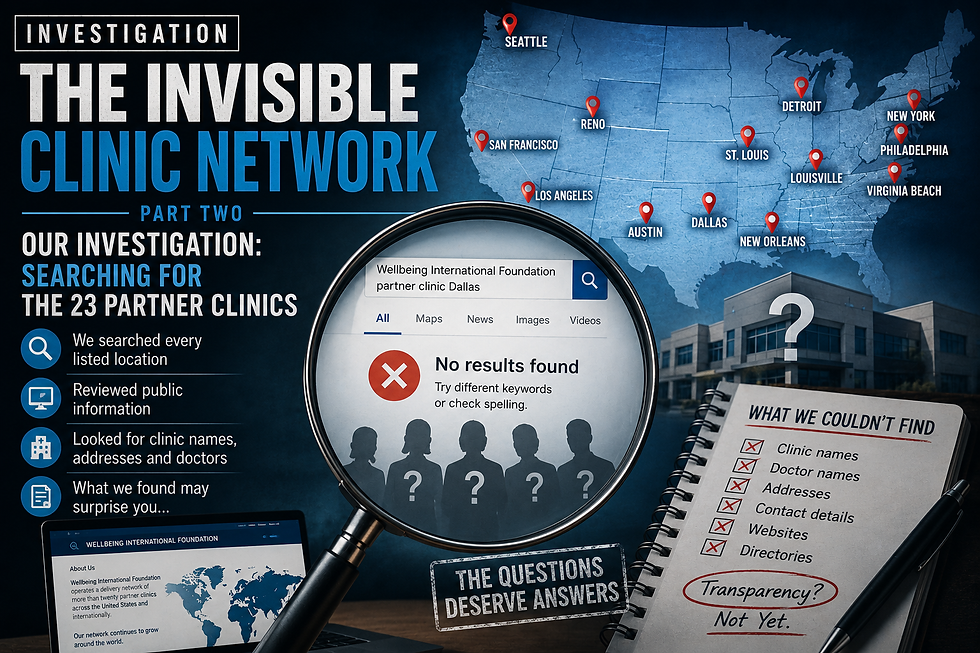
Our Investigation
Having identified the Foundation's published claim that it operates through a network of more than twenty partner clinics, the next step was straightforward: could those clinics be independently identified using publicly available information?
The purpose of this exercise was not to prove or disprove the existence of the network. Instead, it was to determine whether a prospective patient, referring clinician, journalist or researcher could establish who the participating clinics are before making contact with the organisation.
That distinction is important.
Healthcare organisations frequently provide additional information during consultations or after an enquiry has been submitted. This investigation is limited to what is available to members of the public without entering into a commercial or clinical relationship.
Beginning With the Published Information
The Foundation's website identifies a number of cities in which it says its delivery network operates.
These include locations such as Austin, Dallas, Detroit, Los Angeles, Louisville, New Orleans, New York, Philadelphia, Reno, San Francisco, Seattle, St. Louis and Virginia Beach, together with locations outside the United States.
What the website does not immediately provide alongside those locations are the details that many patients would typically expect to find when researching healthcare providers.
For example, the published material does not appear to include:
the names of the participating clinics;
the names of the treating physicians associated with each location;
clinic addresses;
direct clinic telephone numbers;
links to individual clinic websites; or
biographies of the clinicians working within those locations.
That observation should not be interpreted as evidence that such information does not exist. It simply reflects what was publicly available on the material reviewed during this investigation.
Searching for the Clinics
The next stage was to determine whether the listed locations could be connected to identifiable partner clinics through publicly available sources.
The expectation was that a search combining the Foundation's name with one of the listed cities might identify a participating medical practice, physician or treatment centre.
For example, if a patient wished to receive treatment in Seattle or Dallas, it would be reasonable to expect that they could identify the clinic responsible for delivering that care.
However, our review did not identify a publicly available directory maintained by the Foundation listing participating clinics by name.
Likewise, we did not identify a page allowing prospective patients to select a city and view the corresponding clinic, medical team or contact details.
Again, this is an observation rather than a conclusion. The information may exist elsewhere or may be supplied directly to prospective patients during the enquiry process. The point is simply that it was not readily identifiable through the public-facing information reviewed.
Why Does This Matter?
For many businesses, limiting public information about commercial partners may be an entirely reasonable commercial decision.
Healthcare, however, occupies a different position.
Medical treatment depends upon informed decision-making.
Patients often wish to understand not only the treatment being proposed but also who will be delivering it.
Questions such as these are entirely ordinary:
Which doctor will perform my treatment?
Where is the clinic located?
What is the clinic's regulatory status?
What experience does the medical team have?
What professional registrations do the treating clinicians hold?
These are questions that patients routinely ask before committing to private medical treatment.
The ability to identify participating clinics also allows independent verification.
Medical professionals can evaluate referral options.
Journalists can verify public claims.
Researchers can understand how a healthcare network is structured.
Patients can make comparisons with other providers.
Transparency benefits everyone involved.
Comparing Public Information
Many established healthcare providers publish detailed information about each clinical location within their network.
This commonly includes:
the clinic's name;
full address;
contact information;
medical specialties;
treating clinicians;
appointment procedures; and
regulatory information where applicable.
Publishing this information does not, by itself, indicate clinical quality.
Nor does the absence of such information necessarily imply any deficiency.
However, the level of publicly available information influences how easily patients and independent observers can understand the structure of an organisation.
In this case, the Foundation's published material emphasises geographical reach while providing comparatively limited information about the individual clinics that make up that network.
That distinction became one of the central observations of this investigation.
The Difference Between Cities and Clinics
Another point emerged during the review.
The published locations are cities rather than identifiable medical facilities.
This may appear to be a minor distinction, but from a healthcare perspective it is significant.
A city may contain hundreds of medical practices.
Simply identifying "Dallas" or "Seattle" does not tell a prospective patient which clinic participates in the network, who owns it, or who will ultimately be responsible for treatment.
The distinction between a city and a clinic is therefore more than semantic.
It relates directly to transparency.
Healthcare is ultimately delivered by identifiable professionals working within identifiable facilities.
Understanding who those professionals are—and where those facilities are located—is an important part of informed decision-making.
Questions That Naturally Follow
The more we examined the publicly available information, the more the same practical questions emerged.
If there are more than twenty partner clinics, are all currently active?
Do all provide the same treatments?
Are they permanent members of the network or occasional collaborators?
Do patients have a choice of clinic?
How are clinicians selected?
How does a patient determine which clinic is appropriate for their circumstances?
These are not allegations.
They are the kinds of practical questions that prospective patients may reasonably ask when considering significant medical treatment.
An Opportunity to Clarify
It is entirely possible that the Foundation has answers to each of these questions and provides that information during its patient onboarding process.
If so, publishing a directory of participating clinics—or otherwise making more detailed information publicly available—could help prospective patients better understand the network described on its website.
For that reason, this investigation should not be viewed as reaching a final conclusion.
Rather, it identifies an area where additional transparency could assist patients, clinicians and independent observers alike.
In the next section of this investigation, we examine why organisational transparency is particularly important in international healthcare networks and consider the practical implications for patients seeking treatment across multiple jurisdictions.


Comments