The Illusion of Infrastructure?
- Bernie Madoff
- Jun 12
- 5 min read

Bermuda, Harley Street and the Search for Wellbeing International Foundation
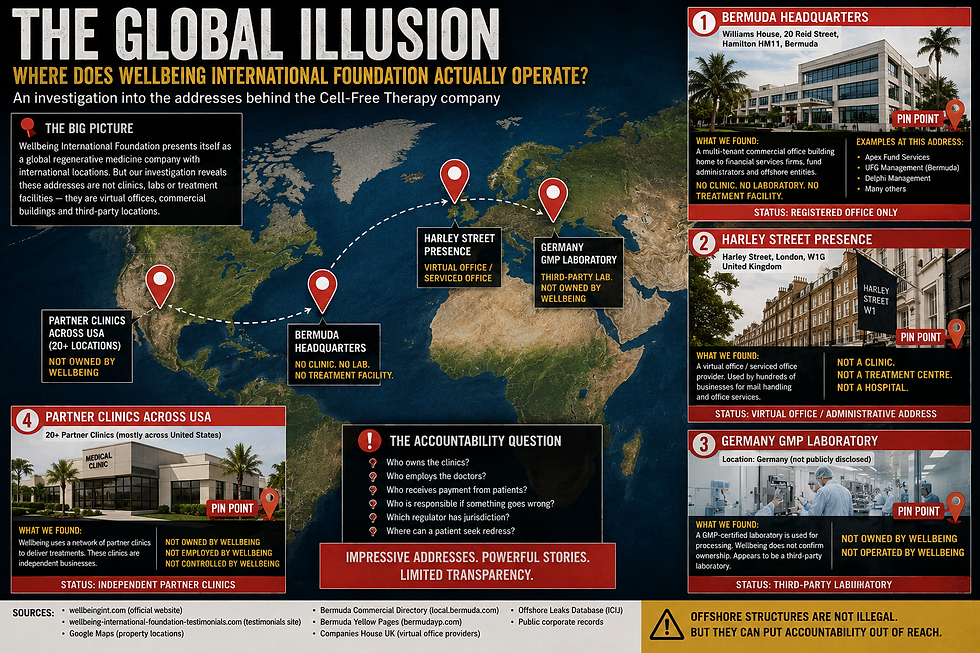
For most people researching a medical treatment, appearances matter.
A company with an international headquarters, a presence on London's prestigious Harley Street, a laboratory in Germany, professional athlete endorsements, and clinics across multiple countries sounds substantial. It sounds established. It sounds like the kind of organisation that must have a large operational footprint behind it.
But what happens when you start looking behind the marketing?
That question led us to examine the publicly stated infrastructure of Wellbeing International Foundation, the organisation behind the increasingly promoted "Cell-Free Therapy" (CFT).
What we found raises important questions about transparency, accountability, and where this organisation actually operates.
The Bermuda Headquarters
Wellbeing International Foundation publicly identifies its headquarters as:
Williams House20 Reid StreetHamilton HM11Bermuda.
The address appears throughout Wellbeing's websites, including both its primary corporate website and its separate testimonial platform.
At first glance, the Bermuda headquarters creates the impression of an international biotechnology organisation operating from its own corporate base.
However, publicly available records tell a different story.
Williams House is a well-known commercial office building in central Hamilton. Public directories show multiple fund administrators, offshore financial companies, investment firms, and corporate service providers operating from the same address. Examples include Apex Fund Services Holdings Ltd., UFG Management (Bermuda), and other financial-sector businesses.
The address also appears repeatedly within offshore corporate databases associated with Bermuda-registered entities.
What we did not find was evidence of:
A Wellbeing medical clinic.
A Wellbeing treatment centre.
A Wellbeing laboratory.
A patient-facing medical facility.
An infusion centre.
Based on publicly available information reviewed during this investigation, Williams House appears to function as a commercial office location rather than a medical facility.
That distinction matters.
Bermuda's Reputation as an Offshore Hub
Hamilton is not primarily known as a biotechnology centre.
It is known globally as one of the world's major offshore financial centres.
According to publicly available information, Bermuda hosts thousands of international companies and is a major centre for insurance, reinsurance, investment funds, and offshore corporate structures.
Again, there is nothing illegal about being based in Bermuda.
Many legitimate businesses operate there.
However, when a company is selling expensive medical-related services, consumers naturally want to know:
Why Bermuda?
What operations actually take place there?
How many employees are based there?
What medical activity occurs there?
Those questions remain unanswered.
The German Laboratory
Wellbeing states that it operates with a GMP-certified laboratory in Germany.
But the company does not clearly identify on its public-facing materials whether that laboratory is:
Owned by Wellbeing.
Operated by Wellbeing.
Leased by Wellbeing.
A third-party partner laboratory.
This may sound like a technical distinction, but it is an important one.
If the laboratory belongs to an independent organisation, then consumers deserve to know the precise relationship between the parties.
Who is responsible for processing biological material?
Who is responsible for quality control?
Who carries legal liability?
At present, the public information provides few answers.
The Partner Clinic Model
Perhaps the most revealing statement on Wellbeing's website is found within its own description of operations.
The company states:
"Headquartered in Hamilton, Bermuda, with our GMP-certified laboratory in Germany, Wellbeing International Foundation operates a delivery network of more than twenty partner clinics."
Notice the language carefully.
The company does not say:
"Our clinics."
It says:
"Partner clinics."
That single word changes everything.
A partner clinic model may mean the organisation itself does not own treatment centres and instead relies upon independent third-party facilities.
That raises important questions:
Who owns the clinics?
Who employs the doctors?
Who assesses patients?
Who obtains informed consent?
Who is medically responsible if complications occur?
Who carries malpractice liability?
The public-facing material does not clearly explain this structure.
The Harley Street Question
The same questions emerge when Wellbeing references Harley Street connections.
Harley Street carries enormous marketing value.
For over a century, it has been associated with elite medicine, specialist consultants, and private healthcare.
But a Harley Street address alone does not automatically indicate the presence of a fully functioning medical facility.
Harley Street contains:
Medical practices.
Consulting suites.
Serviced offices.
Meeting rooms.
Virtual office services.
Mail handling facilities.
The critical question is not whether an address exists.
The critical question is:
What actually happens there?
Is it a treatment facility?
A consulting room?
An administrative office?
Or simply a correspondence address?
Consumers deserve clarity.
Building an International Image
When viewed together, the structure becomes interesting.
A prospective patient encounters:
A Bermuda headquarters.
A German laboratory.
Harley Street associations.
Professional athlete endorsements.
A dedicated testimonial website.
Partner clinics across multiple countries.
The overall impression is one of a large integrated global healthcare organisation.
Yet when individual pieces are examined, much of the operational infrastructure appears to involve third parties, partner organisations, external facilities, and addresses that are not obviously medical treatment centres.
That does not prove wrongdoing.
But it does create a transparency question.
How much of the infrastructure belongs directly to Wellbeing?
The Testimonial Network
This becomes even more significant when viewed alongside Wellbeing's separate testimonial website.
The company operates an entirely separate website devoted exclusively to patient and athlete success stories. The site uses the same Bermuda address and corporate identity as the primary organisation.
Testimonials describe recovery, performance improvements, resilience, healing, and positive health outcomes.
At the same time, the main website includes a disclaimer stating that Cell-Free Therapy is not intended to diagnose, treat, cure, or prevent disease.
This creates an obvious tension.
The disclaimer appears cautious.
The testimonials appear persuasive.
The result is a marketing environment where emotional stories often become more prominent than independently verified evidence.
The Accountability Question
Ultimately, this investigation is not about whether Wellbeing International Foundation is right or wrong.
It is about accountability.
If a patient purchases treatment through this system:
Who receives the money?
Which legal entity signs the contract?
Which regulator has jurisdiction?
Which doctor carries responsibility?
Which company carries liability?
Where does a patient go if something goes wrong?
These are not hostile questions.
They are the basic questions every consumer should be able to answer before spending significant sums on any medical or health-related intervention.
Conclusion
Our investigation found that Wellbeing International Foundation's publicly listed headquarters is located within a commercial office building in Bermuda that is also home to multiple financial and offshore entities. We found no publicly available evidence that this address operates as a clinic, laboratory, or treatment facility.
The company states that it relies on a German laboratory and a network of partner clinics to deliver its services.
That may be entirely legitimate.
But it also means that patients deserve greater transparency regarding who owns what, who performs what, and who is accountable for what.
In healthcare, trust should never depend solely on impressive addresses, celebrity endorsements, or testimonials.
Trust should be built on clarity.
And at present, there are still many unanswered questions.


Comments