The Danger of Unregistered Stem Cell Clinics: Why Patients Must Check Before They Trust
- Bernie Madoff
- May 29
- 7 min read

The promise from Wellbeing International Foundation Ltd. is often irresistible.
Patients suffering from chronic illness, neurological conditions, autoimmune disorders, injuries, chronic pain, autism-related conditions, degenerative disease, or simply the effects of ageing are increasingly being targeted by clinics claiming that stem cells, exosomes, extracellular vesicles (EVs), regenerative medicine, or advanced biological therapies can transform their lives.
The marketing is frequently powerful. Websites display images of laboratories, doctors in white coats, scientific terminology, patient testimonials, and references to cutting-edge medical breakthroughs. Some clinics claim access to treatments from overseas laboratories. Others describe themselves as pioneers in regenerative medicine. Many suggest they can offer hope where conventional medicine has failed.
For desperate patients and worried families, such claims can be incredibly persuasive.
However, one of the most important questions any patient should ask before handing over thousands—or even tens of thousands—of pounds is surprisingly simple:
Is the clinic properly registered and operating within the appropriate regulatory framework?
It is a question that could potentially save patients from financial loss, medical complications, and devastating disappointment.
Why Registration Matters
In the United Kingdom, healthcare regulation exists for a reason.
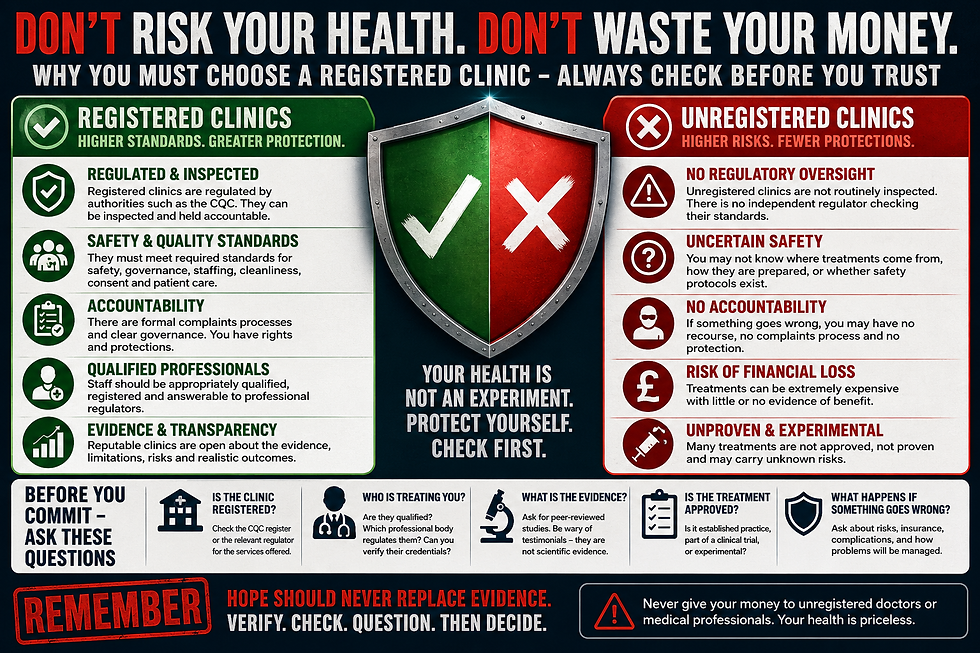
The Care Quality Commission (CQC) acts as the independent regulator of health and social care services in England. The organisation exists to help ensure that services meet required standards of safety, effectiveness, governance, patient protection, and accountability. According to the CQC, organisations carrying out regulated healthcare activities are generally required to register before providing those services.
Registration is not simply a paperwork exercise.
It requires providers to demonstrate appropriate governance, systems of care, safeguarding procedures, clinical oversight, patient protection measures, staff suitability, and regulatory compliance. Registered providers can be inspected, monitored, and held accountable for failures in care.
For patients, registration provides an additional layer of protection.
Without that framework, questions naturally arise regarding oversight, accountability, patient safety procedures, complaint handling, clinical governance, and professional responsibility.
Wellbeing International Foundation Ltd. is not found on any UK register that we can find in the public domain?
The Rise of the Regenerative Medicine Marketplace
Over the past decade, regenerative medicine has become one of the fastest-growing sectors in private healthcare.
Legitimate scientific research into stem cells continues around the world. Researchers are exploring potential applications for a range of serious conditions. In carefully controlled environments, stem-cell-based therapies have shown genuine promise in specific medical fields.
However, experts have repeatedly warned that the commercial market has expanded far faster than the underlying scientific evidence.
A growing number of businesses now market treatments using phrases such as:
Stem cell therapy
Regenerative medicine
Exosome therapy
Extracellular vesicle therapy
Cellular medicine
Anti-ageing therapy
Biological optimisation
Advanced immune therapies
Many of these treatments are offered privately and can cost thousands of pounds.
Patients often encounter sophisticated marketing campaigns that blur the distinction between experimental science, ongoing research, and proven clinical treatment.
The result is a marketplace where vulnerable people may struggle to distinguish legitimate healthcare providers from businesses operating in regulatory grey areas.
Why Vulnerable Patients Are Most at Risk
The people most frequently targeted by these marketing campaigns are often those with the greatest need.
Many are living with chronic illnesses.
Others have exhausted conventional treatment options.
Some are caring for children with complex medical conditions.
Others are dealing with progressive neurological disorders or debilitating pain.
When conventional medicine provides limited answers, patients naturally begin searching elsewhere.
That emotional vulnerability creates a significant risk.
Families may be persuaded to travel abroad, spend life savings, remortgage homes, use credit facilities, or borrow money in pursuit of treatments that are presented as groundbreaking solutions.
Unfortunately, hope can sometimes become a commercial product.
Patients deserve clear evidence, transparent information, and proper regulatory oversight before making life-changing decisions.
Registration Is Not a Guarantee of Success—But It Is a Vital Safeguard
It is important to be fair and accurate.
Registration alone does not guarantee that a treatment will work.
Nor does registration automatically validate every claim made by a healthcare provider.
However, registration does provide an important layer of scrutiny and accountability.
A registered provider operates within a framework where regulators can inspect services, investigate concerns, assess governance arrangements, and intervene when standards fall below acceptable levels.
When dealing with unregistered providers, patients may find that many of those safeguards are absent or significantly reduced.
This becomes particularly important when treatments involve injections, biological products, laboratory-derived materials, or interventions being marketed for serious medical conditions.
Questions Every Patient Should Ask
Before agreeing to any treatment, patients should consider asking the following questions:
Is the clinic registered?
Patients should verify whether the provider is registered with the appropriate regulator and whether the activities being carried out fall within the relevant regulatory framework.
Do not rely solely on statements contained within marketing material.
Check independently.
Who is responsible for patient care?
Identify the clinician responsible for treatment decisions.
What are their qualifications?
What professional body regulates them?
Are they licensed to practise?
Can those credentials be independently verified?
What evidence supports the treatment?
Ask for published evidence.
Request peer-reviewed studies.
Be cautious of providers relying solely on testimonials, personal stories, celebrity endorsements, or anecdotal success claims.
Testimonials are not scientific evidence.
Is the treatment approved?
Patients should understand whether the treatment is established clinical practice, part of a regulated clinical trial, or an experimental intervention.
Those distinctions matter enormously.
What happens if something goes wrong?
Ask about complaints procedures.
Ask about insurance.
Ask who assumes responsibility for adverse outcomes.
Ask how complications will be managed.
If clear answers are not available, that should raise concerns.
The Problem With Medical Marketing
One of the most significant issues identified by investigators and regulators is the increasing sophistication of healthcare marketing.
Many websites use language that sounds scientific without necessarily providing meaningful evidence.
Terms such as:
Revolutionary
Groundbreaking
Advanced
Regenerative
Cellular
Biological
Personalised
can create a powerful impression.
However, impressive terminology should never replace evidence.
Patients should remain cautious when websites rely heavily on emotional storytelling while providing limited clinical data.
The presence of professional branding, luxury offices, laboratory imagery, or expensive websites should not be confused with proof of effectiveness.
A well-designed website is not the same thing as scientific validation.
Financial Harm Can Be Severe
The consequences are not limited to health concerns.
Financial losses can be substantial.
Investigations into private healthcare markets have repeatedly shown that vulnerable consumers may spend significant amounts pursuing treatments that offer uncertain benefits.
Some patients undergo multiple rounds of treatment.
Others are encouraged to continue long-term programmes.
Families sometimes spend savings accumulated over decades.
In certain cases, individuals may travel internationally, incurring accommodation, transport, consultation, and treatment costs running into many thousands of pounds.
When outcomes fail to meet expectations, the financial impact can be devastating.
Transparency Should Never Be Optional
A trustworthy healthcare provider should welcome scrutiny.
Patients should never feel uncomfortable asking questions.
Providers should be willing to explain:
Their regulatory status
Their professional qualifications
Their evidence base
Their safety procedures
Their complaint processes
Their governance arrangements
Transparency builds trust.
Evasion destroys it.
If straightforward questions generate defensive responses, patients should consider whether they are receiving the level of openness expected from a healthcare provider.
The Importance of Independent Verification
One recurring theme seen across numerous healthcare investigations is the danger of relying solely on information provided by the business itself.
Patients should verify claims independently wherever possible.
That means checking:
Regulatory registrations
Professional registrations
Company records
Published research
Regulatory warnings
Inspection reports
Never assume that claims made in promotional material have been independently verified.
Independent verification is one of the strongest protections available to consumers.
A Growing Need for Public Awareness
The regenerative medicine sector will likely continue expanding.
Scientific research is progressing rapidly.
Legitimate innovation undoubtedly exists.
Many researchers and clinicians are conducting important work that could shape the future of medicine.
However, genuine scientific progress also creates opportunities for exploitation.
Unscrupulous operators can hide behind complex terminology, emerging science, and public misunderstanding.
That is why public awareness is essential.
Patients must understand the difference between hope and evidence.
They must understand the difference between marketing and medicine.
Most importantly, they must understand the value of regulatory oversight.
The Bottom Line
If a clinic like Wellbeing International Foundation Ltd. is asking you to trust them with your health, your family, and your money, then asking questions is not unreasonable—it is essential.
Before agreeing to any stem cell, exosome, extracellular vesicle, regenerative medicine, or biological therapy treatment, patients should carefully investigate who is providing the service, whether appropriate regulatory requirements are being met, and whether independent evidence supports the claims being made.
Registration is not merely a bureaucratic formality.
It is one of the most important safeguards designed to protect patients from harm.
In an industry where treatments can cost thousands of pounds and where hope is often the most powerful selling tool of all, consumers must remember a simple principle:
Never hand over your money simply because someone claims to have the answer. Verify first. Ask questions. Check registrations. Demand evidence.
Your health may depend on it.
Editor's Note and Consumer Protection Disclaimer
This article forms part of an ongoing consumer-awareness and investigative reporting project examining the marketing, regulation, and provision of stem cell, exosome, extracellular vesicle (EV), and regenerative medicine treatments.
The purpose of this article is to encourage patients and consumers to carry out appropriate due diligence before entering into any medical treatment agreement or making financial commitments relating to healthcare services.
Readers should be aware that regulatory requirements vary depending on the nature of the treatment being offered, the location in which services are provided, and the activities being undertaken by a clinic or healthcare provider. The existence or absence of registration with a regulator does not, in itself, prove the effectiveness or ineffectiveness of any treatment, nor does it automatically indicate wrongdoing by any individual or organisation.
Consumers are strongly encouraged to independently verify any claims made by healthcare providers and to consult the relevant regulatory bodies before proceeding with treatment. This may include checking registrations, licences, inspection reports, professional qualifications, and any publicly available regulatory information.
Patients should be particularly cautious where treatments are marketed as revolutionary, breakthrough, cutting-edge, or capable of treating a wide range of unrelated medical conditions without clear supporting evidence from peer-reviewed scientific research.
No healthcare decision should be based solely on marketing materials, testimonials, social media content, or verbal representations made during consultations.
This publication makes no allegation of wrongdoing against any specific individual, clinic, doctor, company, or healthcare provider unless expressly stated and supported by evidence. Any references to organisations, treatments, products, or services are made for journalistic, educational, consumer-awareness, or public-interest purposes only.
Where concerns exist regarding a healthcare provider, patients should seek independent medical advice and contact the appropriate regulatory authority for guidance.
The overriding principle remains simple:
Before trusting anyone with your health or your money, verify their credentials, verify their registrations, and verify the evidence behind their claims.


Comments