Stephen Ray’s Microvesicle Patents: Following the Intellectual Property Behind Cell-Free Therapy

The Men Behind Wellbeing — Chapter Five
Wellbeing International Foundation credits Stephen Ray with decades of research behind its Cell-Free Therapy. Patent records provide something more concrete: a documented intellectual-property trail involving microvesicles that reaches back to 2008. But what do those patents actually establish—and what do they not prove?
In the previous chapter, we reached an important point in the investigation.
Andrew Chancellor has publicly described how his relationship with scientist Stephen Ray developed into discussions about commercialising Ray's research.
That raised an obvious question:
What exactly was being commercialised?
To begin answering it, we need to move away from interviews, biographies and promotional material.
We need documents.
And patents provide exactly that.
Patent records identify inventions.
They provide dates.
They name inventors.
They identify applicants and, in some jurisdictions, proprietors or assignees.
Most importantly, they can reveal a scientific and commercial history that existed long before today's corporate branding.
When I began searching those records for Stephen Ray, I found something significant.
A patent family concerning microvesicles.
And its earliest priority claims reach back to 2008.
The Stephen Ray Microvesicle Patent
One of the US records is titled simply:
“Microvesicles.”
The published application identifies:
Inventor: Stephen Ray — Bath, Great Britain
and:
Applicant: Lydac Neuroscience Limited — Bath, Great Britain.
This is important for two reasons.
First, it provides documentary evidence connecting a Stephen Ray in Bath with intellectual property concerning microvesicle technology.
Second, it introduces a company that becomes increasingly important to this investigation:
Lydac Neuroscience Limited.
That means the patent story is not simply about Ray as an individual inventor.
There was already a corporate structure surrounding the technology.
The Patent History Reaches Back to 2008
The patent family does not begin with its later US publication.
The record traces back through international and British applications.
The international application was:
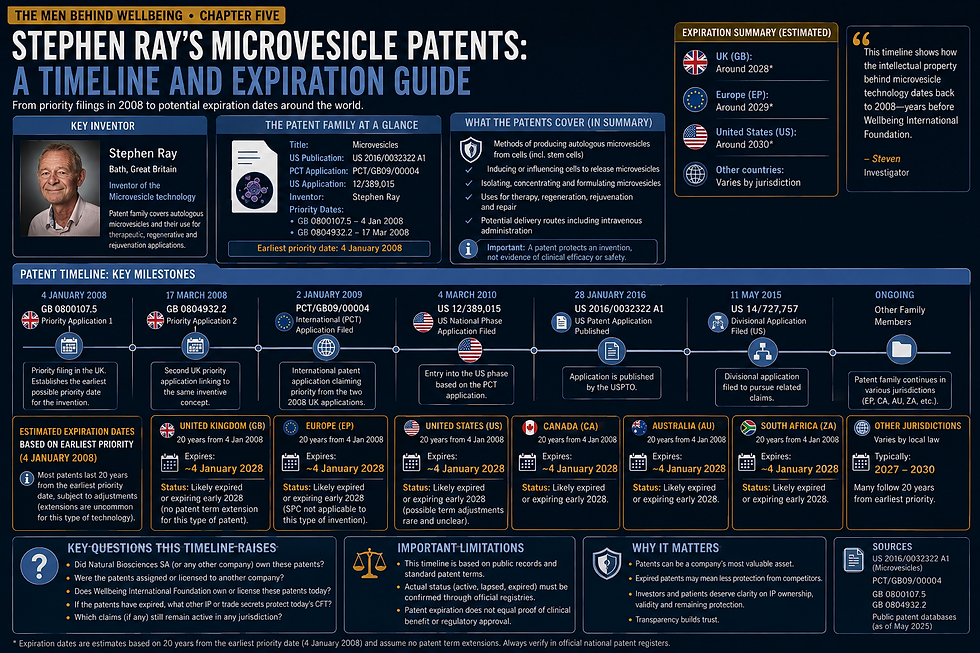
PCT/GB2009/000004
filed on 2 January 2009.
That application claimed priority from two British applications:
GB 0800107.5 — 4 January 2008
and:
GB 0804932.2 — 17 March 2008.
A later US divisional application, published as US 2016/0032322, preserves that earlier priority history.
This materially changes the timeline.
The intellectual-property story surrounding Ray's microvesicle work did not begin with the current Wellbeing organisation.
It stretches back approximately eighteen years.
What Does the Patent Actually Describe?
The patent is technically complex, but its central concept can be explained relatively simply.
It concerns the production and use of microvesicles associated with cells.
Microvesicles are small membrane-bound particles released by cells. They can contain proteins, lipids, RNA and other biological material and can participate in cell-to-cell signalling.
The patent discusses obtaining cells, manipulating or conditioning them, collecting microvesicles released by those cells and potentially using those microvesicles or associated biological material for therapeutic purposes.
It also discusses autologous applications.
Autologous means that the biological material originates from the same individual who may ultimately receive the resulting preparation.
Anyone who has followed Wellbeing's present description of Cell-Free Therapy will immediately understand why this patent caught my attention.
There are obvious conceptual similarities.
But that does not establish that the patented invention and today's CFT product are identical.
That distinction is crucial.
Is This Patent Wellbeing’s Cell-Free Therapy?
At present, I would not make that claim.
Scientific terminology changes.
Manufacturing processes evolve.
Additional intellectual property may have been developed.
A modern treatment can incorporate processes that did not exist when an original patent application was filed.
And patent claims themselves can be considerably narrower than the broad scientific descriptions contained within a specification.
What we can establish is this:
Stephen Ray is named as inventor on intellectual property concerning microvesicles and their potential therapeutic use dating back to 2008.
We can also establish that the concepts described have apparent similarities to aspects of the biological principles Wellbeing now discusses when explaining Cell-Free Therapy.
The precise relationship between the patented technology and today's commercial treatment still needs to be demonstrated.
Regeneration and Rejuvenation Appear in the Patent
The patent becomes particularly interesting when examining its proposed applications.
The specification discusses potential uses involving concepts including:
tissue repair;
regeneration;
and:
rejuvenation.
It also discusses possible therapeutic administration, including intravenous routes.
Those terms obviously resemble language frequently encountered within modern regenerative and longevity medicine.
But there is a major evidential trap here.
A patent discussing a possible therapeutic use does not establish that the proposed use has subsequently been proven effective in human beings.
A Patent Is Not Proof That a Treatment Works
This distinction is perhaps the most important part of this chapter.
Patents are intellectual-property documents.
They are not clinical trials.
A patent can establish that somebody has claimed an invention.
It can potentially protect that invention commercially.
It can become a corporate asset.
It can be licensed.
It can be sold.
It can attract investment.
But a patent does not establish that a medical intervention is safe or clinically effective.
Patent examiners do not replace medical regulators.
Patent examination does not replace randomised controlled trials.
Patent publication does not establish improved patient outcomes.
And the existence of a patent should never be confused with regulatory approval of a treatment.
That distinction becomes particularly important whenever patents form part of the credibility presented to patients or investors.
The Patent Describes an Extremely Broad Range of Possibilities
The specification explores a wide variety of potential applications.
These include areas associated with tissue repair and degeneration as well as other therapeutic and enhancement possibilities.
That breadth may sound impressive.
But patent specifications commonly describe multiple possible embodiments and uses.
An inventor often attempts to protect as much potential application of an invention as legally possible.
Therefore, the presence of a disease, condition or therapeutic possibility inside a patent should not be interpreted as evidence that the technology has successfully treated that condition.
The appropriate question is:
Where is the clinical evidence?
Animal Experiments Appear in the Patent
The specification also discusses experimental work involving animals.
Among the material is discussion of microvesicles in relation to age-associated cognitive decline.
The results are presented positively within the patent documentation, and references are also made to other laboratory work described as unpublished.
That raises an important scientific question.
What happened to those experiments afterwards?
Were the complete results published in peer-reviewed journals?
Were they independently replicated?
Were larger studies conducted?
Did the work progress into formal human trials?
If this experimental research eventually contributed to a technology being administered to paying patients, the scientific development between those early experiments and today's treatment becomes extremely important.
The Missing Peer-Reviewed Trail
This is where the patent history creates an interesting contrast with the scientific publication record we examined earlier.
The intellectual-property roots extend back to 2008.
Historical material suggests related research and treatment activity continued during subsequent years.
Yet one of Wellbeing's most prominent recent peer-reviewed publications—the longevity pilot published in Frontiers in Aging in 2026—involved only fourteen participants completing a programme containing numerous simultaneous interventions.
That study was genuine.
Its peer review was genuine.
But because participants received lifestyle changes, supplements and Cell-Free Therapy together, it could not establish which component produced the observed changes.
The patent history therefore creates an obvious question.
If this technology has been developing for nearly two decades:
Where are the large controlled human trials?
The Patent Record Corrects Part of the Investigation
The discovery also requires an important correction to an assumption that could have emerged from earlier historical material.
In Chapter Four, Natural Biosciences SA appeared in documents connected with Stephen Ray's scientific history.
That initially made Natural Biosciences an obvious candidate when asking who controlled the intellectual property.
But the patent records give us something considerably stronger.
They name:
Lydac Neuroscience Limited.
The early US application identifies Lydac as applicant.
And an official Canadian patent publication from the same international family identifies Lydac Neuroscience Limited as proprietor or assignee, with Stephen Ray identified as inventor.
This is an important distinction.
The documentary evidence presently points towards Lydac Neuroscience Limited as an early corporate rights holder associated with this patent family.
Natural Biosciences remains part of the historical story.
But we should not describe it as the proven original owner of this particular intellectual property unless further records establish that.
Who Was Lydac Neuroscience Limited?
The appearance of Lydac changes the direction of the investigation.
We now need to know:
When was the company incorporated?
Who founded it?
Who were its directors?
Who owned its shares?
What relationship did Stephen Ray have with it beyond being named inventor?
Who financed the company?
What other patents did it control?
Was Andrew Chancellor ever involved?
And eventually:
What happened to Lydac Neuroscience Limited?
Because if it held rights to technology related to Ray's microvesicle research, then the fate of those rights could be extremely important.
Inventor and Patent Owner Are Not the Same Thing
This is another distinction that needs to be clearly understood.
Being named as the inventor does not necessarily mean Stephen Ray personally owned the commercial rights.
Scientists frequently create intellectual property that belongs to their employer.
Inventors can assign patents to companies.
Companies can sell patents.
Patents can be licensed without ownership changing.
Universities can own inventions created by researchers.
Investment companies can acquire intellectual-property portfolios.
Therefore:
Stephen Ray being the inventor and Lydac being the applicant or proprietor are not contradictory facts.
They describe different roles.
Ray created or contributed to the invention.
The corporate rights may have been held elsewhere.
And that leads us directly to the next major question.
Where Did the Intellectual Property Go?
If Lydac held rights connected with the microvesicle technology, what happened afterwards?
Was the patent sold?
Was it assigned?
Was it licensed?
Did Natural Biosciences acquire rights?
Did another company acquire them?
Did Wellbeing eventually acquire them?
Does Wellbeing currently license them?
Or does today's CFT rely on later technology outside the original patent claims?
These are not speculative accusations.
They are ordinary questions of intellectual-property due diligence.
And they should have documentary answers.
The Assignment Trail Matters
Patent ownership does not move invisibly.
Transfers can generate legal records.
Assignments can be registered.
Corporate transactions can identify intellectual property among transferred assets.
Licensing agreements may appear in investment documentation.
Insolvency proceedings may identify patents as company assets.
If the intellectual property travelled from Lydac through other companies and ultimately into Wellbeing, there may be a documentary trail.
That is what we now need to find.
Natural Biosciences Still Matters
The emergence of Lydac does not remove Natural Biosciences from the investigation.
Historical South African material identifies Stephen Ray as chief scientist of Natural Biosciences SA and discusses the organisation in connection with stem-cell research and treatment.
This suggests Ray's work was associated with multiple commercial organisations during the broader development period.
What remains unknown is how those organisations related to one another.
Did Natural Biosciences license technology from Lydac?
Did the companies share ownership?
Was one a successor to another?
Did they operate independently?
Did Ray simply work with both?
Until documentary evidence answers those questions, no connecting corporate ownership should be assumed.
Stephen Ray Has Other Patent History
The microvesicle family is not the only intellectual-property record associated with a Stephen Ray working in this field.
Patent databases also identify applications involving RNA administration.
One is titled:
“Method Of Genotypically Modifying Cells By Administration Of RNA.”
The applicant is identified as Fischer Education Project Limited, with Stephen Ray and Michael Fischer named as inventors.
This suggests that Ray's involvement with patentable biological technology may extend even further back than the microvesicle applications.
That strengthens one part of Wellbeing's story.
There is a genuine historical intellectual-property footprint associated with Ray's name in relevant biological fields.
An investigation must acknowledge evidence that supports the people being investigated just as readily as evidence that raises questions.
This Is Important for Assessing Stephen Ray Fairly
Earlier in this investigation, questions were raised about Ray's scientific background and the evidence behind Wellbeing's technology.
The patent records provide useful additional context.
Whatever conclusions may ultimately be reached about Cell-Free Therapy itself, the documentary evidence supports the proposition that a Stephen Ray associated with Bath was involved with microvesicle-related intellectual property many years ago.
That matters.
The appropriate question is therefore not:
“Did Stephen Ray simply invent a scientific history for marketing purposes?”
The evidence does not support making that accusation.
A much stronger question is:
How did this genuine historical research become the commercial therapy being sold today, and what clinical evidence supports that transition?
That is the question worth pursuing.
The Investment Story Makes Ownership Critical
The intellectual-property trail becomes even more important because Wellbeing is no longer merely selling treatment.
The organisation has also publicly discussed raising investment capital.
Biotechnology investors frequently place enormous value on intellectual property.
Patents can provide competitive barriers.
They can prevent competitors from copying processes.
They can support licensing agreements.
They can influence company valuations.
Therefore, any serious investor considering Wellbeing should reasonably want to establish:
Who owns the relevant patents?
Does Wellbeing own them directly?
Does it license them?
Are licences exclusive?
Which countries are protected?
How long does protection remain?
What exactly do the claims cover?
And does the patented technology actually protect the current Cell-Free Therapy manufacturing process?
Those are fundamental due-diligence questions.
The 2008 Date Creates Another Issue
Patent protection does not last forever.
The exact duration of any patent depends upon jurisdiction, filing history, maintenance, legal status, extensions and other factors.
So it would be irresponsible to simply take a 2008 priority date and declare that every related patent expires on a particular day.
But the age of this patent family makes one question unavoidable:
How much enforceable protection remains today?
If Wellbeing's investment proposition relies significantly upon proprietary intellectual property derived from older patent families, the remaining duration and scope of that protection becomes commercially important.
Again, the answer needs to be established patent by patent.
What We Can Establish So Far
At this stage, several facts are becoming considerably firmer.
A Stephen Ray of Bath is named as inventor on a patent family concerning microvesicles.
The priority history reaches back to British applications filed in 2008.
The patent discusses potential therapeutic applications of microvesicle technology.
Lydac Neuroscience Limited is identified as applicant in the US record.
An official Canadian publication identifies Lydac as proprietor or assignee in the same broader patent family.
Historical evidence separately connects Stephen Ray with Natural Biosciences SA.
And patent databases identify additional biological intellectual property carrying Ray's name.
Those are useful findings.
But there is something we still cannot establish.
We Still Do Not Have the Complete Ownership Chain
This is the missing piece.
We have:
Stephen Ray — inventor.
We have:
Lydac Neuroscience Limited — early applicant/proprietor associated with the microvesicle patent family.
We have:
Natural Biosciences SA — historically associated with Ray's stem-cell research and treatment activities.
And today we have:
Wellbeing International Foundation — commercially promoting Cell-Free Therapy.
What we do not yet have is documentary evidence establishing the complete legal chain connecting those entities.
That is where this investigation goes next.
Conclusion: The Patent Trail Is Real — But It Raises Bigger Questions
The patent investigation has produced an important result.
There is genuine historical intellectual property associated with Stephen Ray's microvesicle research.
Its roots extend back to 2008.
That strengthens the historical scientific narrative surrounding Ray.
But it does not prove Cell-Free Therapy works.
It does not establish clinical efficacy.
It does not establish regulatory approval.
And it does not yet establish that Wellbeing owns the intellectual property.
Instead, the patent has given us something arguably more useful.
A trail.
Stephen Ray.
Microvesicles.
Lydac Neuroscience Limited.
Natural Biosciences SA.
And eventually Wellbeing International Foundation.
Somewhere between those names lies the commercial history of the technology.
The next job is to reconstruct it.
Because if patients are being asked to spend substantial sums on Cell-Free Therapy—and investors are being invited to finance the company behind it—one basic question deserves a completely transparent answer:
Who actually owns the science?
Next: Chapter Six — Who Owned Stephen Ray’s Science? The Lydac Neuroscience Connection
The patent records identify Lydac Neuroscience Limited as an early corporate holder associated with Stephen Ray's microvesicle intellectual property. Now we investigate the company behind the patents, the relationship with Natural Biosciences, and the missing ownership trail leading towards Wellbeing International Foundation.


Comments