Stem Cells: How Far Have We Really Come?
- Bernie Madoff
- Apr 10
- 4 min read

The Science, the Hype, and the Danger of Salesmen Posing as Medicine.
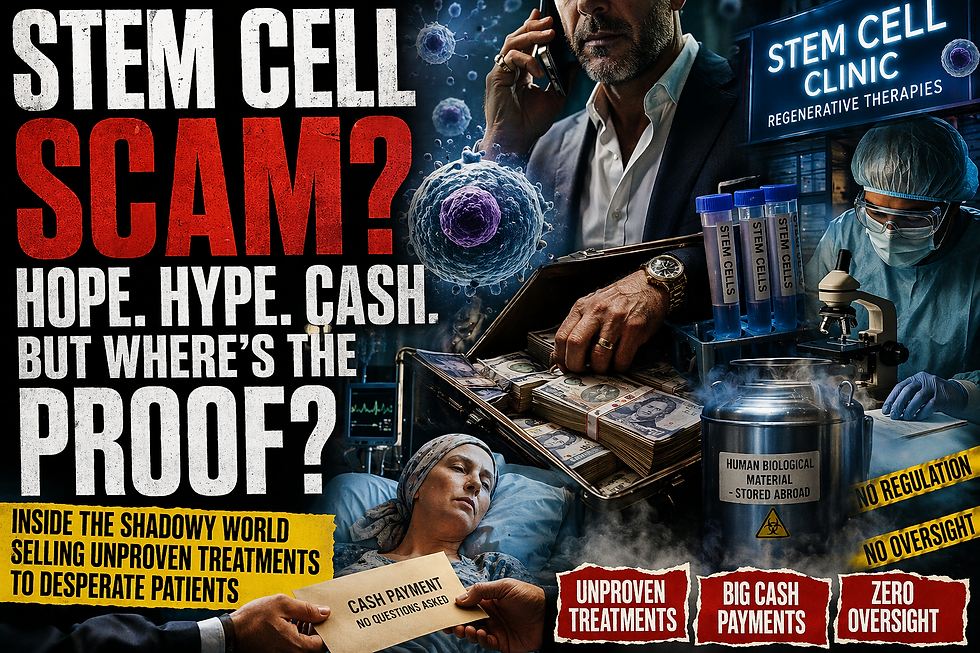
The promise of stem cell science is real. The hype around it is real too. And the gap between those two things is where vulnerable patients can get hurt.
A review paper indexed by PubMed Central, Stem cell therapy: facts and fiction, described stem cell therapy as a field with genuine promise but limited proven clinical application, warning that translation from laboratory research to routine treatment remained narrow and technically difficult. That core message still broadly holds up today.
The first fact that matters is simple: stem cell research is not the same thing as an approved stem cell treatment. Research can be exciting, early, and promising without being ready for commercial sale. The International Society for Stem Cell Research says patients should be cautious, and its treatment guide is built around exactly that distinction: what is scientifically plausible is not always clinically proven.
That is why the number of well-established stem cell treatments remains relatively small. The clearest long-standing example is haematopoietic stem cell transplantation—better known as bone marrow or blood stem cell transplantation—which is used for conditions such as leukaemia, lymphoma, myeloma, and some blood disorders. The NHS describes these as established treatments for diseases affecting blood cells.
Beyond that, the field becomes more specialised and more tightly regulated. The EMA explains that advanced therapy medicinal products, or ATMPs, include medicines based on genes, tissues, or cells, and they must pass formal regulatory pathways. In the UK, MHRA guidance says ATMPs placed on the market must have a marketing authorisation, with quality, safety, and efficacy assessed before they are lawfully marketed.
That matters because stem cells are often sold to the public as though they are already mainstream medicine for everything from joint pain to neurological disease to cancer support. Regulators say otherwise. The FDA warns that regenerative medicine products, including stem cell and exosome products, are widely marketed with misleading claims, and that many such products have not been approved, licensed, or shown to be safe and effective for the conditions being advertised. In March 2026, the FDA again warned consumers to avoid unapproved products made from human cells or tissues that are marketed for a wide range of diseases and conditions.
So where are we really? We are in a world where real science exists, some real therapies exist, and a much larger commercial market exists around treatments that are still experimental, weakly evidenced, unapproved, or misleadingly presented. That is the uncomfortable truth.
The 2012 paper you pointed to is useful because it strips away the fantasy. Its central theme is not that stem cells are fake. It is that the science is promising, but the fiction begins when promise is dressed up as proven medicine. That is still the key dividing line today.
And this leads to the next question: can stem cell treatments truly be offered as a service by businessmen fronting the operation while presenting others as medical authorities? Sometimes a lawful cell-based treatment can be offered through a company structure, but only inside a proper regulatory framework, with licensed products or authorised clinical use, qualified clinicians, informed consent, and truthful marketing. What cannot be brushed aside is the legal and ethical requirement that medical services are actually medical services, not sales funnels dressed up in lab language.
If non-doctors present themselves as doctors, or if non-clinical operators market unapproved interventions as though they are established therapies, the problem is not merely bad taste. It can move into questions of misrepresentation, unlawful promotion, consumer protection, professional regulation, and medicines law, depending on exactly what is being offered and in which jurisdiction. The science does not give anyone a free pass to improvise medicine.
The science also does not support the fantasy that stem cells are already a general-purpose cure service for almost any chronic or catastrophic illness. The ISSCR’s patient guidance stresses caution, and regulators repeatedly warn that broad claims across many diseases are a red flag. That is especially important when clinics or intermediaries promote stem cells or exosomes in sweeping terms to desperate patients.
In plain English, here is the reality.
Stem cell research has come a long way.Scientists have made major advances in understanding stem cell biology, cell differentiation, disease modelling, tissue repair, and clinical translation. Regulators in Europe and the UK now have formal frameworks for genuine cell- and gene-based medicines. Some advanced therapies are approved. Some blood stem cell transplants are standard care.
But no, that does not mean almost any stem cell service being sold to the public is legitimate.A real field of science has grown up alongside a much murkier commercial world where weak evidence, regulatory loopholes, and aggressive marketing can outrun the facts.
That is the heart of the issue. Stem cell medicine is real. Stem cell marketing is often something else entirely.
And when the people doing the selling look more like dealmakers than doctors, patients should ask the most important question of all:
Is this a regulated medical treatment — or just hope being sold at a premium?


Comments