AUTISM AND STEM CELL CLINICS: WHAT FAMILIES SHOULD KNOW BEFORE PAYING FOR EXPERIMENTAL TREATMENTS
- Bernie Madoff
- May 3
- 3 min read

Evidence, Risks, and the Therapies Experts Actually Recommend
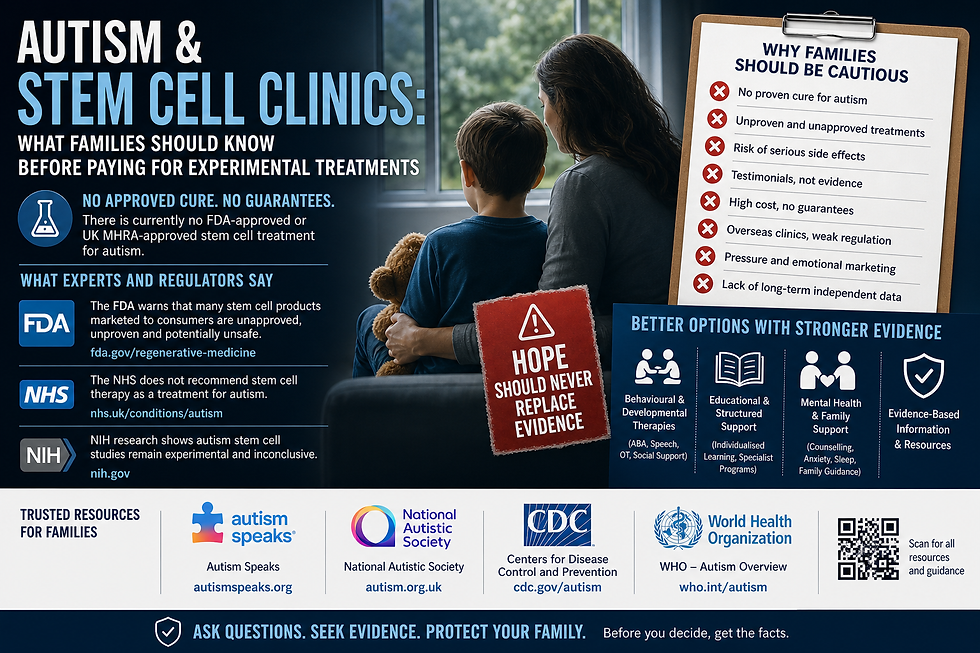
Across the internet, families affected by autism spectrum disorder (ASD) are increasingly being targeted with advertisements for stem cell therapy, exosome therapy, and so-called regenerative medicine programs claiming to offer improvement in speech, behaviour, focus, social interaction, and cognitive function.
The marketing is often emotional, persuasive, and wrapped in scientific terminology.
But major medical authorities continue to warn that families should approach these treatments with extreme caution.
This article is not written to attack legitimate scientific research.
Nor is it intended to accuse every clinic offering regenerative therapies of wrongdoing.
Instead, this investigation focuses on a simple question:
What does the current evidence actually say?
There Is Currently No Approved Stem Cell Cure For Autism
At present:
There is no FDA-approved stem cell treatment for autism in the United States.
There is no MHRA-approved stem cell cure for autism in the United Kingdom.
No major European regulator has approved stem cell therapy as a proven autism treatment.
That does not mean scientific research has stopped.
It means research is still ongoing — and experimental science should not be confused with proven clinical treatment.
What Regulators Have Warned
The U.S. Food and Drug Administration has repeatedly warned consumers about unapproved stem cell clinics marketing treatments for serious medical conditions without sufficient scientific evidence.
The FDA states that many stem cell products marketed directly to consumers are:
Unapproved
Unproven
Potentially unsafe
The agency has also documented reports involving:
Infections
Immune reactions
Blindness
Tumours
Serious complications
FDA Consumer Warning:
The National Institutes of Health has also published ongoing reviews showing that autism stem cell research remains experimental and inconclusive.
NIH Research Overview:
The NHS England does not currently recommend stem cell therapy as a standard treatment for autism.
NHS Autism Guidance:
Why Experts Urge Caution
Autism spectrum disorder is not a single disease.
It is a complex developmental condition involving:
Communication differences
Behavioural variation
Sensory processing differences
Neurological development
Genetic and environmental factors
Because autism itself is highly variable, measuring treatment outcomes becomes extremely difficult.
Many researchers warn that anecdotal improvements reported by parents may sometimes reflect:
Natural developmental changes
Maturation
Behavioural therapy progress
Expectation bias
Placebo-style perception effects
This does not mean parents are dishonest.
It means emotional hope can unintentionally affect perception — especially when families invest significant money and emotion into treatment.
Why Some Families Become Vulnerable
Families raising autistic children often face:
Exhaustion
Financial pressure
Social isolation
Fear about the future
Long waiting lists for support services
This creates an environment where “miracle recovery” marketing can become extremely persuasive.
Investigators have identified repeated patterns within some commercial regenerative medicine advertising:
Emotional before-and-after videos
Testimonials without independent verification
Scientific jargon difficult for non-specialists to challenge
High-cost treatment packages
Claims of “breakthrough medicine”
Overseas clinics operating outside stricter regulation
Treatments With Stronger Scientific Support
While no treatment “cures” autism, there are therapies supported by significantly more clinical evidence than commercial stem cell programs.
These include:
Behavioural and Developmental Therapies
Applied Behaviour Analysis (ABA)
Speech and language therapy
Occupational therapy
Social communication support
Sensory integration support
Educational and Structured Support
Individualised learning strategies
Specialist education programs
Parent-led intervention training
Communication systems
Mental Health and Family Support
Family counselling
Anxiety management
Sleep support
Structured routines
Evidence-Based Information Sources
Autism Speaks
National Autistic Society
Centers for Disease Control and Prevention Autism Resources
World Health Organization Autism Overview
The Financial Question
One of the biggest concerns surrounding commercial stem cell clinics is cost.
Families can spend:
Tens of thousands of pounds
International travel expenses
Accommodation costs
Repeat treatment cycles
Follow-up consultations
often without any guarantee of measurable improvement.
Critics argue that this creates a dangerous imbalance between hope and evidence.
Questions Every Family Should Ask Before Proceeding
Before paying for any experimental autism treatment, families should ask:
Is this treatment approved by major regulators?
What published peer-reviewed evidence exists?
What percentage of patients show no improvement?
Are risks fully documented?
Is this being marketed through science or emotion?
Are improvements independently measured?
Are long-term outcomes available?
The Bottom Line
Stem cell research is a real and evolving scientific field.
But autism remains an extraordinarily complex condition, and current evidence does not support commercial claims of reliable stem cell-based improvement or recovery.
Families deserve:
Transparency
Honest expectations
Independent science
Proper regulation
Evidence before marketing
Because when vulnerable parents are searching for hope, the line between innovation and exploitation can become dangerously thin.


Comments